


What follows is long. It reflects my own attempt to think clearly in a moment when clarity is costly. While this sits somewhat outside my usual apologetics work, the responsibility to speak truthfully here felt unavoidable. The views expressed are my own.
It is often said after tragedies: “Never again.” Those words carry a special weight when the tragedy is antisemitic violence, because they echo the pledge the world made after the Holocaust. But if “never again” is going to mean anything in Australia in 2025, it has to be more than a slogan we repeat while the next outrage loads in the chamber. It has to force one hard question: How did we let it get this far?
The recent massacre at Bondi did not appear out of a clear blue sky. It arrived at the end of two years in which warning signs were not subtle, not hidden, and not rare. They were public, cumulative, and repeatedly explained away.
Intimidation. Vandalism. Doxxing. Arson. Threats. Hatred rebranded as activism. Extremist rhetoric increasingly spoken aloud rather than whispered. Over and over, many people—especially Jewish Australians—said some version of the same thing: this is escalating, and it will not stay “just words.”
A mature democracy does not wait for bodies to pile up before it decides something matters. That’s the uncomfortable truth this moment has exposed. Leadership is not tested by speeches. It is tested by whether the centre holds when it’s being pulled apart. Whether leaders are willing to take moral risk, not just procedural refuge. Whether they can surrender control—through real accountability—rather than trying to manage fallout through internal reviews, media lines, and carefully calibrated statements.
Nobody has a crystal ball. But governments don’t govern terrorism risk by superstition, they govern by risk management. We don’t require certainty before acting on bushfires, pandemics, or organised crime; we act when threat indicators cross known thresholds. Terrorism is no different.
The argument here is not that the State or Federal governments “caused Bondi,” or that they should have identified these exact men in advance. The argument is simpler and more demanding: leadership reduces probability and impact by responding to documented, escalating risk signals—not by waiting for tragedy to convert warning into proof. And when catastrophe arrives, leadership is then tested by whether it submits to the strongest form of accountability, rather than managing the damage through internal process.
Globally, Australia now has a choice to make. We can either drift into the same exhausted pattern we see elsewhere around the world—polarisation, mistrust, communities retreating into fear—or we can reclaim moral leadership by showing what a liberal democracy is actually supposed to do: confront hate without becoming hateful, defend minorities without turning into a censorious state, and punish violence and incitement without punishing legitimate dissent.
This is the tightrope every free society must learn to walk. But walking it requires courage, not slogans. Bondi was not the start of the story. It was the moment the story stopped being deniable.
October 2023
Two days after Hamas’s October 7 massacre of Israeli civilians, Australian officials illuminated the sails of the Sydney Opera House in blue and white to honour Israel’s dead. The gesture was solemn. The response, from some quarters, was not.
On the evening of October 9, around 1,000 pro-Palestinian demonstrators marched through downtown Sydney toward the Opera House, venting outrage at Israel, and, disturbingly, at Jewish Australians themselves. Video footage captured protesters igniting flares and chanting antisemitic expletives. Orange flames lit up angry faces; vile slogans echoed off the Opera House’s white sails. The nation watched a scene that felt imported—and yet unmistakably local.
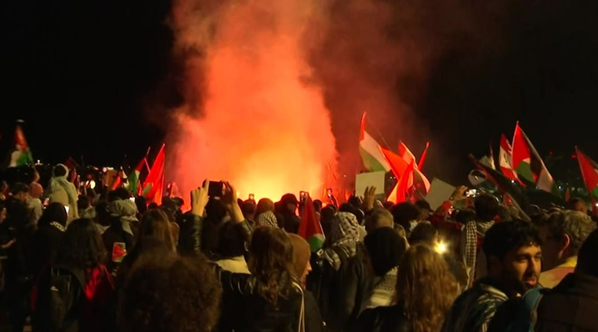
Then came the moment that crystallised it as police advising a small group of Jewish Australians nearby to leave, for their own safety, as the protest grew volatile. Whatever the operational rationale, the optics were chilling: in a country proud of its “fair go,” the people grieving were the ones moved on.
Prime Minister Anthony Albanese condemned the “horrific” antisemitic chants, reminding Australians that “we are a tolerant multicultural nation” and must keep discourse “respectful.” But the Opera House protest would go on to function as an early symbol of the months and years ahead revealing how quickly the Israel-Hamas war could be transplanted onto Australian streets. And it established a precedent: Jews could be publicly targeted, and the first institutional reflex would be to lower the temperature.
2023 – mid 2024
In the weeks and months that followed, anti-Jewish hatred in Australia surged to levels not recorded in recent memory. In its annual report covering 1 October 2023 to 30 September 2024, the Executive Council of Australian Jewry recorded 2,062 incidents nationally—significantly more than the prior year’s total.
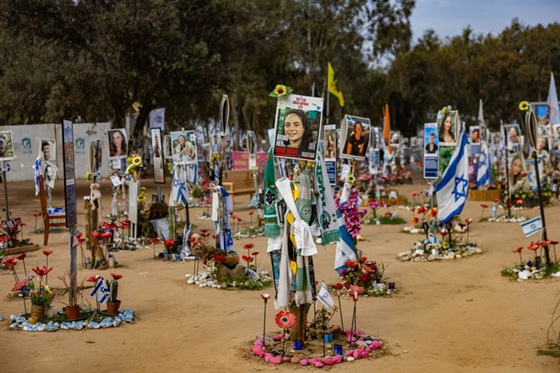
In January 2024, Foreign Minister Penny Wong travelled to Israel and the region. Some Jewish community groups criticised the itinerary for not including highly symbolic massacre sites such as Kibbutz Be’eri or the Nova memorial. No obligation exists to visit any particular site, but in moments of trauma, presence is a form of speech—and absence can be one too.
In February 2024, a private WhatsApp group of Australian Jewish academics and creatives was infiltrated and the personal details of more than 600 members leaked (“Zio600”). Threats and workplace attacks followed; the episode became a vivid example of how online hostility can turn into civic intimidation.
On May 25, 2024, Mount Scopus Memorial College in Melbourne was targeted with antisemitic graffiti (“Jew die”), prompting a police investigation and broad condemnation.
In June 2024, activists vandalised the electorate office of Josh Burns, a Jewish MP, smashing windows, painting slogans, and lighting small fires.
Around this period, there were also documented controversies involving a small number of individual preachers and sermons publicly criticised as antisemitic (and in at least one instance found by a court to contain racist and antisemitic imputations). Of course, these cases were not representative of Australian Muslims as a whole, but they intensified concern precisely because they occurred in religious settings where moral authority is formative.
Late 2024
By late 2024, the targeting became more explicit—less like ambient anger and more like deliberate signalling.
On October 13, 2024, a Jewish-owned bakery in Sydney (Avner’s Bakery, owned by TV chef Ed Halmagyi) was defaced with an inverted red triangle and a threatening note: “Be careful.”
On October 17, 2024, the Curly Lewis Brewing Company near Bondi was deliberately set alight. Police later linked it to the broader wave of antisemitic incidents in Sydney’s east, and authorities indicated it may have been mistakenly targeted instead of a nearby kosher deli.
On October 20, 2024, the kosher deli Lewis’ Continental Kitchen in Bondi was deliberately set on fire in what was treated as an antisemitic arson attack.
On November 21, 2024 in Woollahra, a car was set on fire and around 10 vehicles and multiple buildings were vandalised with anti-Israel / antisemitic graffiti including “f*** Israel,” with damage estimates exceeding $100,000.
Then the same area was hit again on December 11, 2024, with another car fire and additional antisemitic/anti-Israel vandalism reported.
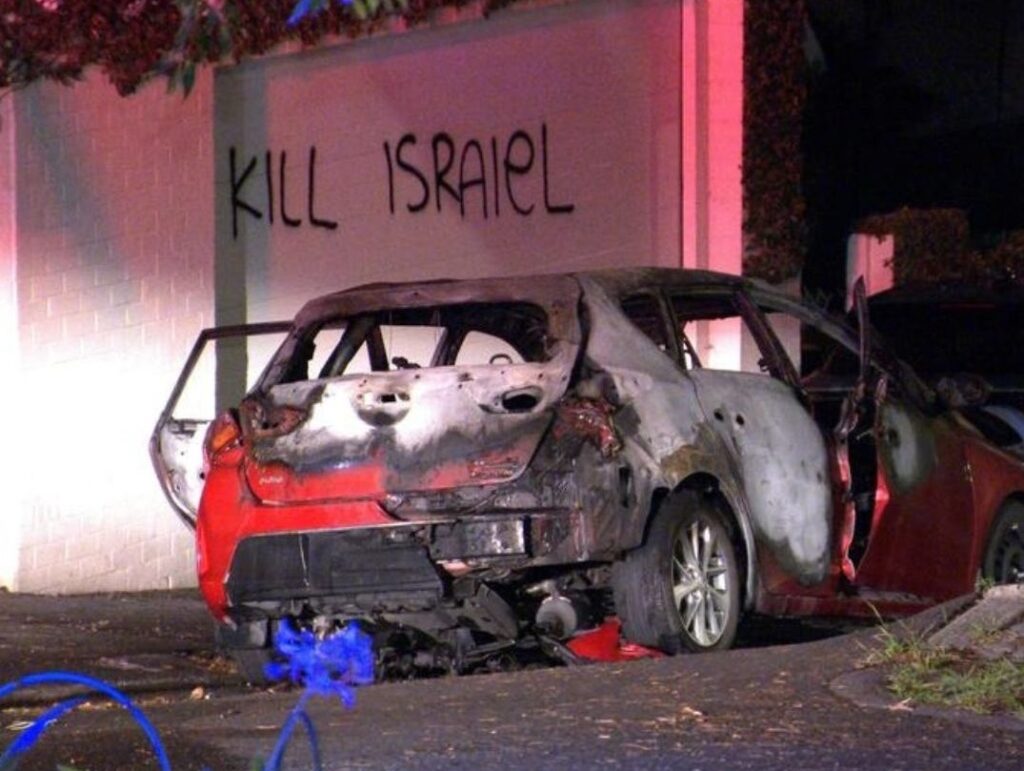
On December 6, 2024, masked intruders broke into the Adass Israel Synagogue in Ripponlea, Melbourne and firebombed it, in an incident treated as a suspected terror attack and investigated by a Joint Counter-Terrorism Team. The aftermath eventually revealed something worse than local hatred: intelligence agencies said that operatives linked to Iran’s Islamic Revolutionary Guard Corps (IRGC) had planned and funded the synagogue arson—as well as the Bondi deli firebombing—via local criminal proxies.
On December 9, 2024, the Australian Federal Police announced a dedicated antisemitism task force, Special Operation Avalite, to investigate high-harm antisemitic threats and violence nationwide.
By the end of 2024, Australian Jews were on high alert. Community security groups were beefed up; an online “Antisemitism Register” tracked incidents nationwide. Threats, assaults, vandalism, and intimidation had roughly tripled in the year after October 7.
What began with chants at the Opera House had escalated to attempts to burn Jewish institutions with people inside. Far-right neo-Nazi agitators helped poison the air—swastikas appeared, fringe groups held rallies—but the most lethal threats were increasingly tied to Islamist extremism, whether homegrown or directed from abroad.
Early 2025
In January 2025, the incident stream broadened and intensified:
- January 7, 2025: A man was charged after allegedly making threatening gestures toward worshippers near synagogues in Sydney’s St Ives area.
- January 10-11, 2025: Synagogues in Sydney (including Allawah and Newtown) were vandalised with Nazi-linked graffiti; in Newtown, police said vandals attempted to set the building alight.
- January 16, 2025: Special Operation Avalite made its first arrest (alleged death threats online).
- January 17, 2025: Cars were set alight and a house vandalised in Dover Heights in an antisemitic attack.
- January 21, 2025: A childcare centre in Sydney’s east was set alight and sprayed with antisemitic graffiti (“F*** the Jews”).
- January 29, 2025: Police investigated a caravan found in Dural containing explosives and antisemitic-linked material as a potential terror threat (later reporting questioned its credibility).
In February 2025, ASIO director Mike Burgess delivered a blunt public warning: antisemitism had become the number one threat to life in Australia. The warning arrived into a society already absorbing incidents that felt like cracks in something deeper than order: cracks in moral self-confidence.
Then came something that felt, to many Australians, like a moral shattering:
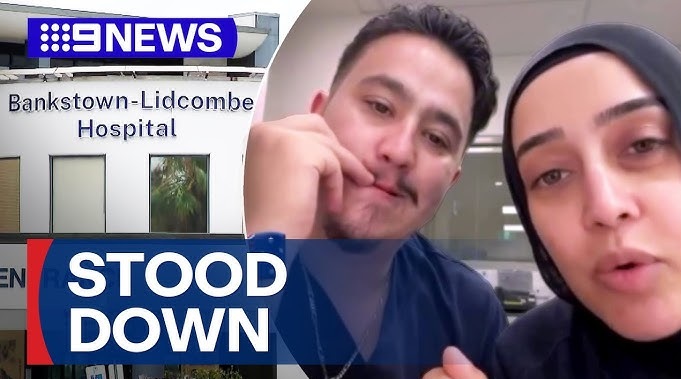
Two nurses at a Sydney hospital appeared in a viral TikTok video threatening to kill Jewish patients. The woman said she would not treat Jewish patients—she’d kill them instead—while the man bragged he had sent “many Israeli patients to hell.” The public was rightly horrified. Licences were suspended; criminal charges followed. Albanese lamented that “the language… is completely abhorrent” and urged Australians not to let overseas conflicts “import division” into multicultural communities. But the shock lingered: genocidal language was no longer confined to anonymous comment threads. It had entered a place designed to preserve Australian lives.
Mid 2025
On 4 July 2025, a fire was lit at the East Melbourne Synagogue while congregants were inside observing Shabbat; people evacuated and no one was killed. Police charged a man and the motive was investigated amid heightened community tension.
On 24 July 2025, Jewish fifth-graders from Melbourne on a museum excursion were accosted by older students from another school who shouted “dirty Jews,” “baby killers,” and “Free, free Palestine” leaving 10- and 11-year-old children distressed and prompting a wellbeing response from school leadership.
Amid this climate, the government’s Special Envoy for Combating Antisemitism, Jillian Segal, delivered a long-awaited Plan to Combat Antisemitism. Appointed in July 2024 as Australia’s first antisemitism envoy, Segal produced a 20-page report containing 13 recommendations and 49 key actions. These included adopting the International Holocaust Remembrance Alliance (IHRA) definition of antisemitism; expanding legal provisions to cover violent or intimidating protest activity; withdrawing public funding from institutions that fail to address antisemitism; tightening visa screening; establishing a national database of incidents; and strengthening education for schools, police, and courts. Her warning was unequivocal: “When hatred goes unchallenged, our democracy is at risk… There is no place for antisemitism in modern Australia.”
The government’s response was cautious and incremental. Some measures were implemented in 2025, including criminal penalties for displaying Nazi symbols and salutes, strengthened anti-doxxing laws, the criminalisation of hate speech that incites violence, the creation of a National Student Ombudsman for universities, and increased funding for Holocaust education centres and Jewish museums. In August 2025, the Albanese government also took the extraordinary step of expelling Iran’s ambassador over what authorities described as state-directed antisemitic arson attacks—the first expulsion of a foreign envoy from Australia since the Second World War. Tehran rejected the allegations as “baseless,” but Australian officials were explicit: a foreign state had used Australian soil to target Jewish communities.
That assessment was reinforced in November 2025, when the government listed the Islamic Revolutionary Guard Corps (IRGC) as a state sponsor of terrorism under Australia’s new Criminal Code framework.
Yet several of Segal’s more robust recommendations remained stalled or contested. Proposals to withdraw public funding from universities or research bodies that tolerate antisemitism drew fierce criticism as heavy-handed or “Trumpian,” with even some Jewish voices expressing concern about coercive use of funding. Similarly, proposals to tighten visa screening on the basis of antisemitic beliefs raised unresolved free-speech questions and remained under review. The result was a pattern that had become familiar: acknowledgment of the problem, selective action, and hesitation at the point where enforcement would require sharper political risk.
Late 2025
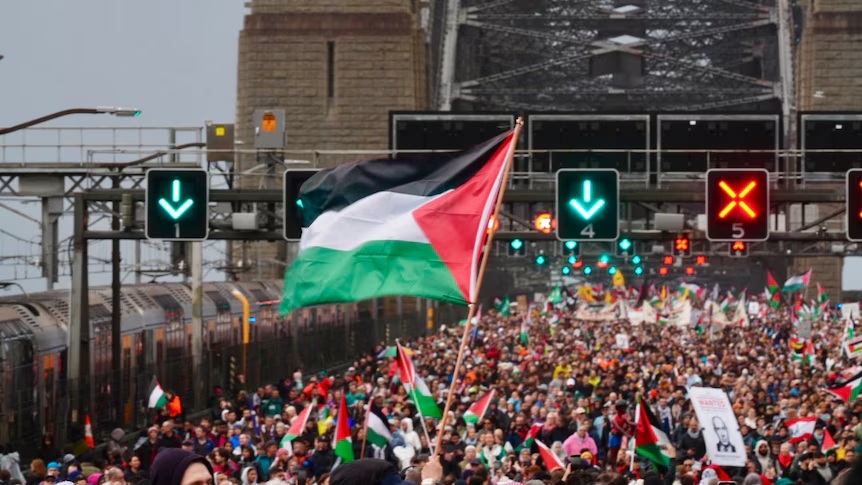
On 3 August 2025, tens of thousands marched across Sydney’s iconic Harbour Bridge in a “March for Humanity” calling for peace and aid for Gaza. It was an extraordinary event in scale and symbolism: one of the largest political demonstrations in modern Australian history, conducted across a national landmark normally reserved for civic unity rather than partisan mobilisation.
Peaceful dissent is legitimate in a democracy, and that must be said plainly. Many who marched did so in good faith. But there were also many who did not. Within and around the march, militant rhetoric and extremist symbolism appeared, including imagery associated with foreign regimes and movements openly hostile to Israel and, in some cases, to Jews more broadly. These elements were not necessarily dominant, but they were visible, tolerated, and largely uncontested. Several elected officials and public figures were photographed participating beneath placards bearing such imagery, lending the event an air of institutional normalisation.
Tony Burke, Minister for Home Affairs, was the cabinet member charged with translating concern into enforcement. But no serious attempt was made by authorities to enforce clear legal or civic boundaries separating peaceful protest from intimidation, glorification of violence, or the laundering of extremist symbolism into mainstream space. And for that to happen signals that the state is not neutral. It communicates permissiveness. And permissiveness erodes deterrence.
On 11 August 2025, the government announced it would recognise a Palestinian state at the UN General Assembly, framing the decision as grounded in commitments received from the Palestinian Authority and as an investment in a future two-state settlement. The decision took effect on 21 September 2025.
Taken in isolation, the move was taken by some as a principled move of social action. Taken in context, it was not. It came at a moment when terrorist strongholds in the region remained politically active, when the war in Gaza had intensified rather than stabilised, and when domestic antisemitic intimidation in Australia was already escalating. Whatever its moral intent (and that debate is legitimate) the decision functioned as a signal in a deteriorating risk environment. Leadership is judged not only by the values it invokes, but by its sensitivity to timing, incentives, and escalation dynamics. Governments do not act in a vacuum; they act into charged environments where signals matter. On that measure, the governments timing was not merely unfortunate. It was strategically reckless, delivered at a point when deterrence was already fraying rather than consolidating.
Then December came. Bondi came. The moment that demanded moral overcorrection arrived after hesitation had already been normalised. By the time the words were spoken, they sounded less like leadership than like procedure—the final line of a speech delivered after the curtains had caught fire, while everyone pretended the blaze had appeared without warning.
The Aftermath
In the aftermath, the shortcomings were not difficult to identify. The Prime Minister’s public presence was limited and carefully managed: an initial appearance, a visibly strained reception, and then a retreat to controlled settings. What was notably absent was sustained, visible solidarity in the places where grief had concentrated most intensely. When asked about attending funerals, the response was procedural—“if invited”—at a moment when leadership is often judged less by protocol than by moral initiative.
Policy emphasis also shifted quickly toward safer terrain. Public commentary focused on gun regulation and the need to “turn down the temperature,” reframing a targeted, ideologically motivated atrocity as a generalised governance challenge. And when calls emerged for the clearest mechanism of independent accountability available—a federal royal commission with coercive powers—the government declined, opting instead for an internal review. The contrast is difficult to ignore: royal commissions for administrative and financial failures; managerial process for the worst act of terrorism on Australian soil in history.
None of these decisions were unprecedented, nor entirely without rationale. But leadership is not assessed by precedent alone. It is assessed by whether it recognises when a moment requires overcorrection rather than continuity.
That choice exposed a deeper instinct that has surfaced repeatedly over the past two years. Faced with moral crisis, the government has tended toward containment rather than confrontation, balance rather than decisiveness, process rather than the surrender of control that genuine accountability demands. Ministers emphasised the importance of free expression and social cohesion, yet enforcement remained uneven. Diplomatic restraint and de-escalation were articulated abroad, while domestically the cumulative effect of mixed signals—on protests, on rhetoric, on recognition, on accountability—was to blur the very boundaries the state exists to uphold.
In such environments, extremists do not require endorsement. They require only ambiguity.
None of this is to suggest that the Prime Minister or his ministers caused the Bondi attack. That claim would be false and irresponsible. The point is more sobering, and more consequential: leadership shapes risk long before it shapes response. It raises or lowers deterrence. It signals what will be tolerated, what will be confronted, and what will be endlessly contextualised.
By the time Bondi occurred, Australia had spent nearly two years normalising hesitation in the face of escalating antisemitism. When the moment finally demanded moral overcorrection—the full, humbling act of independent accountability—the state chose instead to remain within its institutional comfort zone.
The Choices We Face
“Never again” cannot survive on ceremony alone. It has to be a discipline: a willingness to act while the escalation is still reversible, and to submit to real accountability when it isn’t.
Attacks like Bondi threaten not just Jews, but the foundations of civil society. Jillian Segal’s warning has the same moral logic: antisemitism is never “just” hatred of Jews. It is an attack on the fairness, equality, and mutual respect that make pluralism possible. When antisemitism grows, something more general decays: the assumption that we are one people under one law.
And what of Bondi beach itself? This iconic stretch of sand that, for decades, has been a shorthand for Australian life at its most open and uncomplicated?
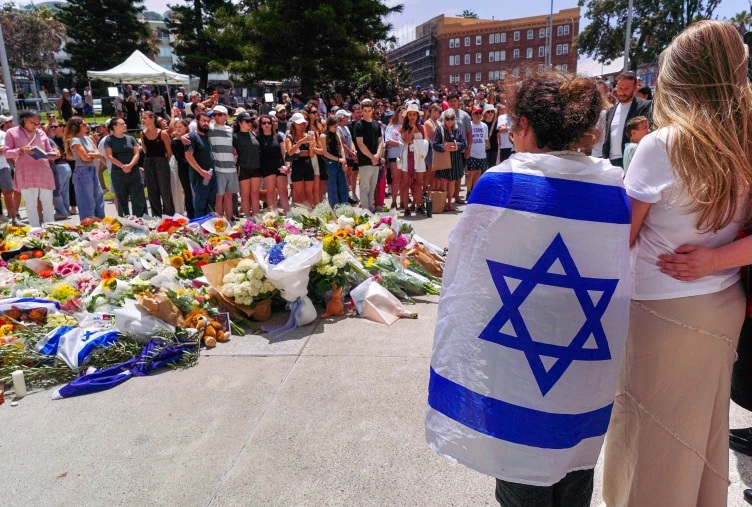
In the days after the massacre, flowers and candles and handwritten prayers filled the site. Someone planted 15 Australian flags in the sand, one for each life lost—people who came to celebrate Hanukkah and were murdered for it. Their names and stories are now woven into Bondi’s story. Yet within a week, Australians returned by the thousands—not in fear, but in solidarity. Surfers paddled out beyond the break and formed a circle, splashing water upward in tribute. On the shore, people of different faiths held hands. A banner fluttered: “We will swim again.”
That banner is more than sentiment. It is something of a civilisational statement.
But to reach that day, Australia has learned—painfully—that vigilance is the price of peace. And leadership is tested not by how eloquently one condemns evil after it happens, but by how decisively one acts when the warning signs appear, and how honestly one submits to accountability when catastrophe strikes.
This is why the critique of political leaders—and the broader political class—is not necessarily “partisan noise” or just adding to the “culture wars.” It is democratic maintenance. In a democracy, we (ideally) hold leaders to account not because we enjoy tearing down institutions, but because we want them to function. We demand seriousness because the stakes are human lives, social trust, and the future of a pluralistic society.
“Never again” is not a vow we make to history. It is a vow we make to the living.
And for some of us, that conviction runs even deeper. It rests on the belief that human life is not valuable because the state grants it dignity, or because society agrees to protect it, but because it is first given dignity—before law, before politics, before tribe.
The Christian story insists that when violence and hatred rise, God does not respond with abstraction or distance, but with presence—entering human history, bearing the cost of evil, and exposing it without mirroring it.
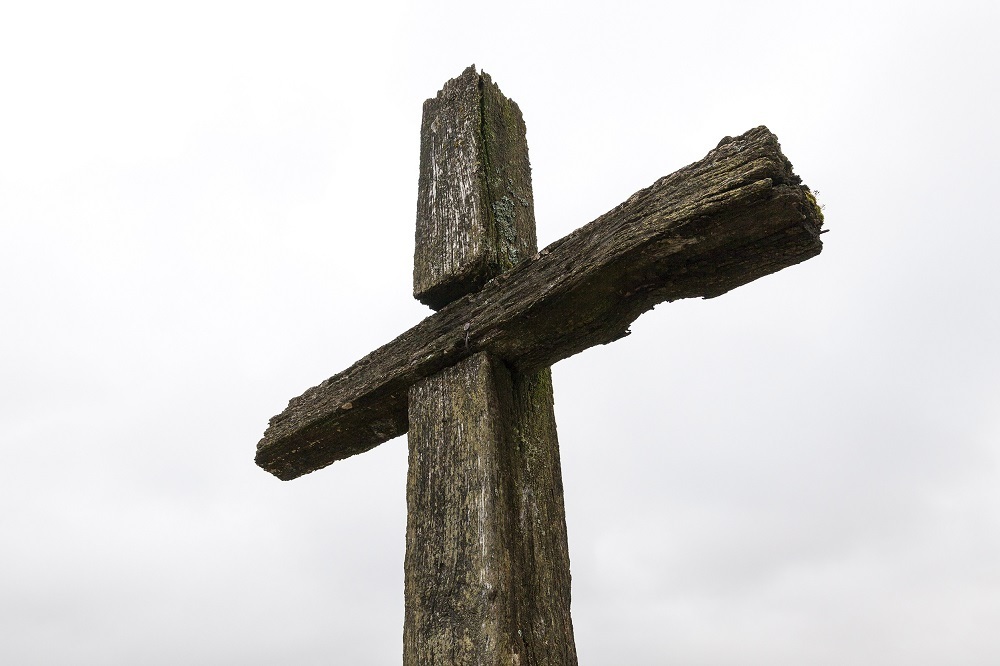
That is why Christians cannot be indifferent when hatred is normalised, nor reckless in how we resist it. The cross refuses both passivity and vengeance. It names evil truthfully and then absorbs its force rather than passing it on.
Why Write This?
In November 2024 I sat in a room of Messianic Jewish scholars and fellow believers at the ETS/EPS annual meeting in San Diego, CA—men and women who live with a kind of historical memory most of us only borrow. Hearing the stories and sharing the tears of those who had suffered antisemitism in the October 7 attacks and its aftermath, I found myself convicted.
After the session, I stood up as the only Aussie in the room and shared my enormous encouragement at the fellowship and shared theology within the room. I also spoke about my conviction as an evangelist, navigating the complexities of the theological-political landmines both in and outside the church that can be stumbling blocks to a “mere Christian” presentation. And then I confessed to the room that I feel silence, in part, is precisely what enables the escalation of antisemitism.
Immediately after sharing this, a Messianic Jewish couple came over to me and hugged me… I mean, proper hugged me. Then they looked me in the eye and with conviction said: never forget Jesus was a Jew. And yet as a Jew, “When he was reviled, did not revile in return; when he suffered, did not threaten, but continued entrusting himself to him who judges justly…” The male happened to be a professor at a well-known Christian Seminary and gave me his number, saying: “any time you need support, text me.”
So why am I writing?
Because I left that room with a weight I couldn’t shake. If we keep treating antisemitism as someone else’s problem—an issue to condemn in general terms, but never to name with clarity—then we will keep watching it escalate until the only “proof” left is bodies. And they won’t only be Jewish bodies.
Because whatever else people want to do with this moment—spin it, weaponise it, relativise it, fold it into their preferred narrative—the one thing we cannot do is pretend it came out of nowhere. Evil thrives on vagueness. Hatred thrives on amnesia. And silence, however well-intentioned, becomes permission when it is repeated long enough.
Because this is not about partisanship. It’s about democratic maintenance. It’s about whether a pluralistic society still knows how to defend its minorities without becoming hateful, and how to confront hate without dissolving into moral equivalence.
Because I don’t have much to offer beyond what God has put in my hands. I don’t run a security agency. I’m not a legislator. I don’t command institutions or hold political office. But I have a keyboard, and with God’s help I’ll use it to combat hate without being hateful.


