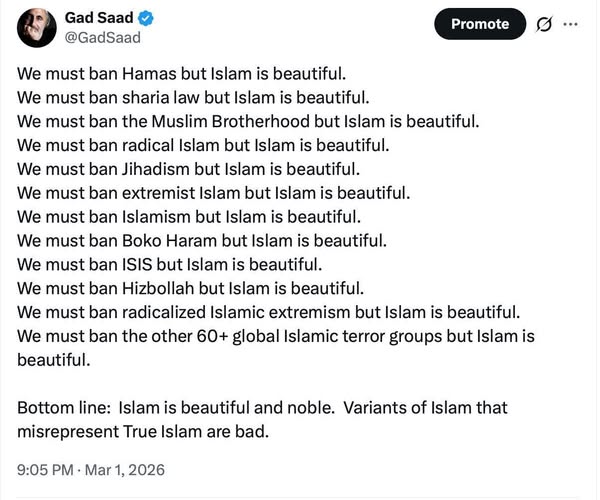
Granted: the majority of Muslims worldwide reject violent extremist interpretations and often suffer under them. Many victims of ISIS, al-Qaeda, Boko Haram, etc., are Muslim. So the question “Is Islam beautiful or evil?” is perhaps too blunt.
But here’s what isn’t too blunt: “That’s not real Islam” can’t be the end of the conversation when the violence is justified from within Islam’s own sources, institutions, and history.
If extremists can consistently recruit, preach, and persuade using recognisably Islamic language, then we owe the truth the courtesy of asking why, without collapsing into collective blame.
Hard questions worth asking:
- Do some theological strands within Islam lend themselves more easily to political absolutism (law + state + sacralised violence)?
- What do serious Muslim reform movements actually do with those strands – reinterpret, marginalise, or deny they exist?
- How do liberal democracies combat violent extremism without sliding into scapegoating ordinary Muslims?
- Is it coherent to condemn Islamism while treating the broader tradition as morally untouchable?
Every major religion has been implicated in violence when fused with state power – Christianity included. So the question isn’t “Has this tradition ever produced violent actors?” The question is: what internal brakes does the tradition have, and are they strong enough to resist the political-theological fusion extremists keep exploiting?
And on that specific test, Christianity is not just “another version of the same thing.”
Christianity’s centre is a crucified King who refuses the sword be weilded in His name, and commands love of enemy. The Christian faith’s proper mode of spread is persuasion, not compulsion. So when Christians have used violence “in God’s name,” it hasn’t been obedience to Christ – it’s been contradiction of Him. That’s why “internal brakes” aren’t a side issue. They’re the issue.